Craft Brewery Yield KPIs: Mash Efficiency, Runoff Time, Extract Variance, and Tank Utilization
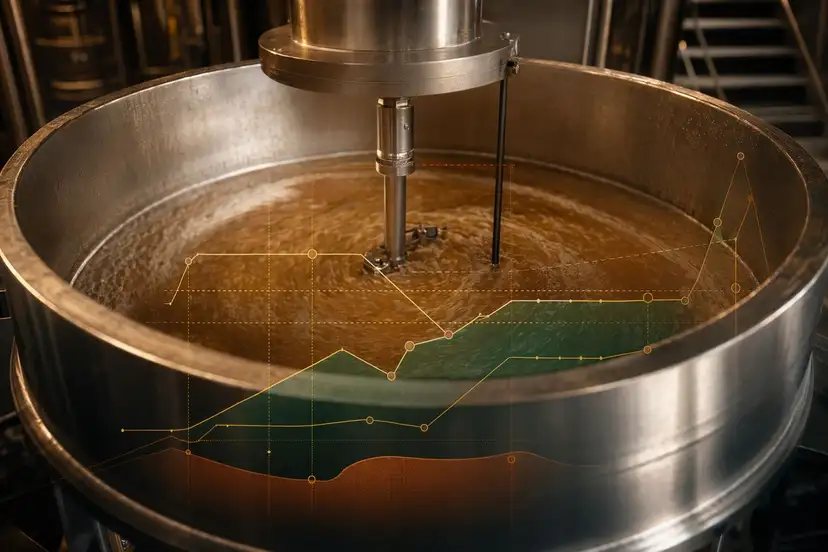
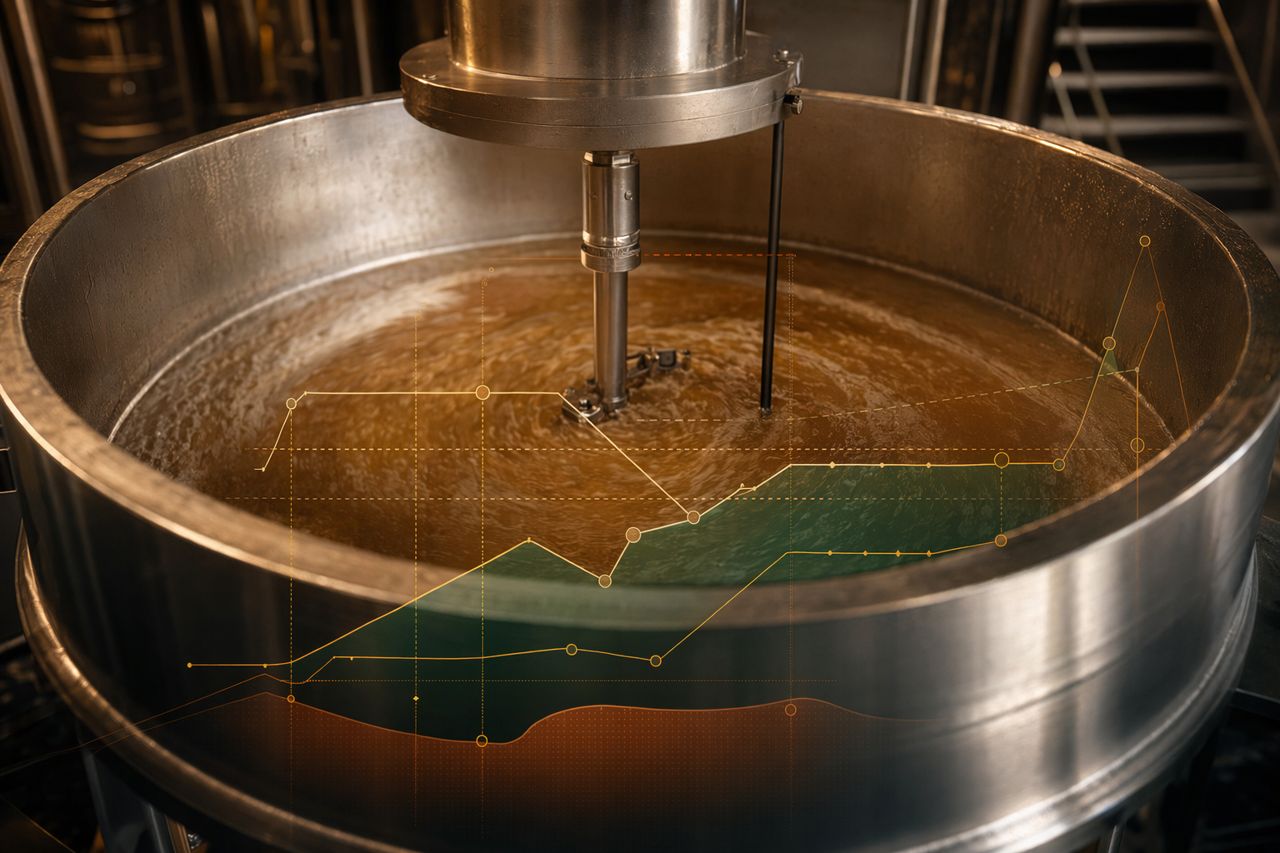
Yield is not one number. In a working craft brewery, yield shows up as a set of connected signals: how much extract you recover from malt, how long the lauter takes, how tightly wort gravity lands against target, how predictably beer ferments, and how fast tanks become available for the next turn.
Mashwright works as a brewing enzyme supplier for craft breweries that want better brewhouse consistency without flattening beer character. The goal is practical: improve the process conditions that affect yield while protecting the malt profile, body, foam, and flavor intent of the recipe.
Why yield KPIs matter more than a single brewhouse efficiency number
Brewhouse efficiency is useful, but it can hide the operating cost behind the result. A beer may hit extract target while costing extra time in the lauter tun. A high-gravity wort may look good on paper while creating extract variance batch to batch. A faster runoff may help the day, but only if the beer still lands where the brewer intended.
For craft breweries, yield tracking should connect four production questions:
- Are we recovering extract consistently from the grist?
- Are we moving wort through the mash and lauter without bottlenecks?
- Are we reducing gravity variation from batch to batch?
- Are fermentation and tank schedules becoming easier to plan?
Enzymes can support those outcomes when they are selected around the recipe, malt stream, brewhouse design, and KPI target—not treated as a generic shortcut.
KPI 1: Mash efficiency
Mash efficiency reflects how effectively starches and soluble material move from grist into wort. In practical terms, it is shaped by malt modification, crush, mash temperature profile, liquor-to-grist ratio, pH, mixing, and conversion time.
When mash efficiency drifts, the cause is often not one dramatic failure. It is usually a collection of small process changes:
- A new malt lot behaves differently under the same crush.
- Adjunct inclusion changes gelatinization and conversion behavior.
- Mash viscosity increases and extract movement slows.
- Conversion is technically complete but less predictable against the target gravity.
How enzyme support can help
Amylase-focused support can improve starch breakdown and help brewers steer fermentability. In beers where body and residual sweetness matter, the objective is not simply “more attenuation.” The objective is to place fermentability where the recipe needs it and keep it there across production runs.
For a craft brewery, that may mean:
- More reliable extract pickup from variable malt.
- Better gravity control in high-gravity or adjunct recipes.
- Reduced need for corrective dilution or extended mash holds.
- Cleaner comparison between brews because the mash is less noisy.
KPI 2: Runoff time
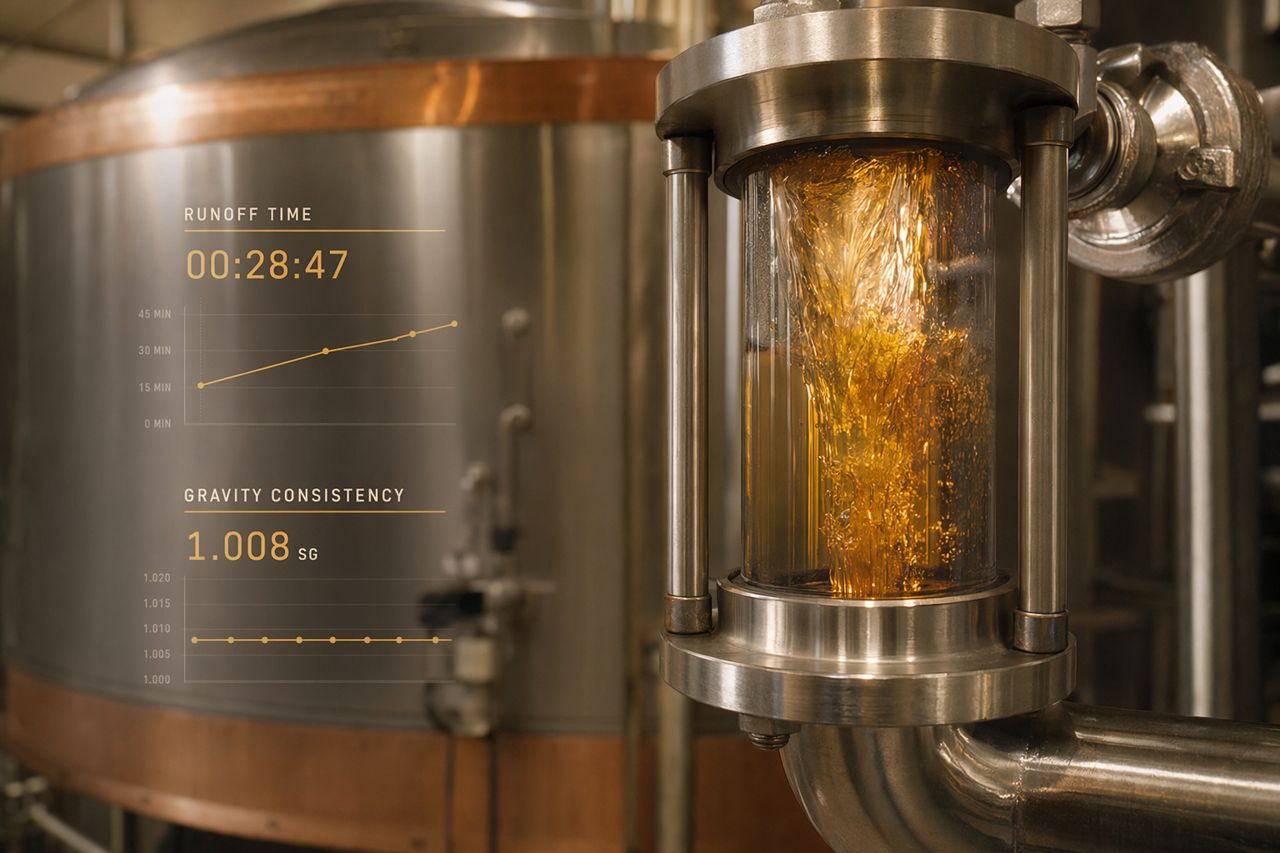
Runoff time is where yield and scheduling meet. A sticky mash can turn a normal brew day into a queue. Slow collection can delay kettle fill, push knockout later, and create pressure on cellar turns.
Long runoff is commonly tied to wort viscosity and the physical behavior of the grain bed. Malt beta-glucans, arabinoxylans, high adjunct loads, under-modified grain, or aggressive flour from milling can all contribute.
What to track
Useful runoff tracking does not need to be complicated. Record:
- Time from vorlauf start to kettle full.
- First-wort clarity observations.
- Rake or bed intervention notes.
- Lauter differential pressure, if available.
- Wort gravity at defined collection points.
- Recipe, malt lot, adjunct percentage, and mash rest notes.
Over time, these notes show whether the issue is recipe-specific, malt-lot-specific, seasonal, or equipment-related.
How enzyme support can help
Beta-glucanase and related viscosity-management support can help reduce the gumminess that slows wort movement. The value is not only speed. It is predictability.
A more manageable mash can support:
- Smoother runoff without over-sparging.
- Lower risk of stuck or dragging lauters.
- More repeatable kettle-fill timing.
- Better use of brewhouse labor and utilities.
KPI 3: Extract variance
Extract variance is the difference between target and actual extract over repeated brews. This KPI is especially important for breweries packaging flagship beers, rotating hazies, fruited bases, lagers, or high-gravity styles where small changes cascade through fermentation and sensory outcomes.
Extract variance can appear as:
- Original gravity drifting from target.
- More frequent brewhouse corrections.
- Fermentation finishing higher or lower than expected.
- Package alcohol targets becoming harder to hold.
- Sensory variation that is difficult to trace.
Use enzyme strategy to reduce process noise
A well-matched enzyme program helps narrow the range of mash behavior. That does not remove the brewer’s judgment. It gives the brewer cleaner inputs.
For example:
- Amylase support can help stabilize conversion performance.
- Viscosity-targeted support can make extract movement less dependent on difficult runoff conditions.
- Protease support, where appropriate, can help tune nitrogen availability and wort composition while respecting foam and mouthfeel targets.
The right approach depends on the beer. A crisp lager, a malt-forward brown ale, a high-adjunct IPA base, and a strong stout should not be treated the same.
KPI 4: Tank utilization
Tank utilization is often discussed as a cellar metric, but the brewhouse influences it early. If mash conversion varies, if runoff stretches, or if fermentability misses target, tanks can sit longer than planned.
Enzyme-supported consistency can help the production team plan with more confidence:
- Brew days land closer to schedule.
- Fermentation profiles become easier to compare.
- Bright tank timing is less reactive.
- Packaging windows are easier to protect.
The value is not only more beer per tank. It is fewer schedule surprises.
The brewer-to-brewer KPI checklist
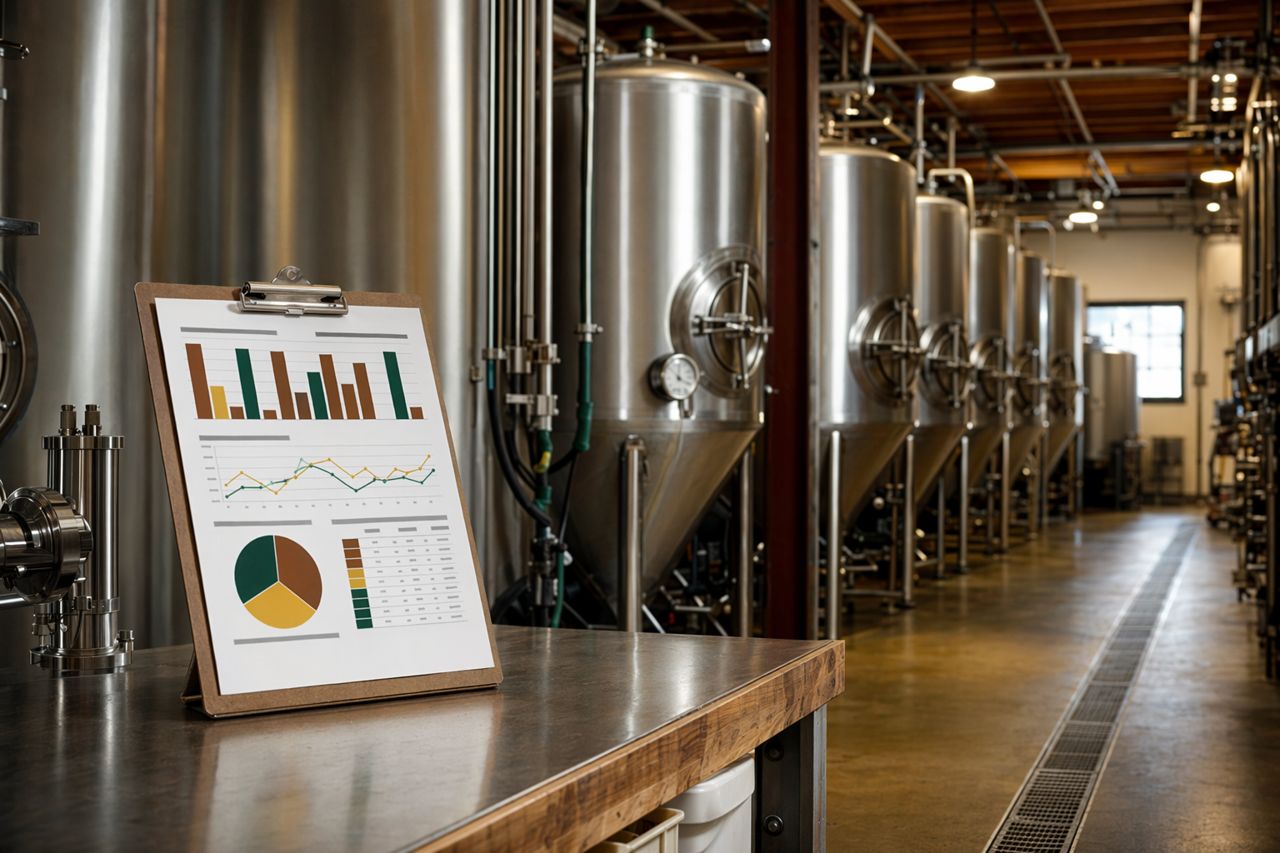
Before changing anything, build a baseline. For each target recipe, capture at least several normal production runs and log the same data every time.
Mash and lauter data
- Grist bill and malt lot.
- Crush setting and mill observations.
- Mash-in temperature and rest profile.
- Mash pH and any adjustment notes.
- Conversion timing notes.
- Vorlauf start, runoff start, and kettle-full time.
- Any bed disruption, raking, compaction, or slow-zone notes.
Wort and fermentation data
- Pre-boil gravity and volume.
- Post-boil gravity and volume.
- Knockout gravity and temperature.
- Fermentation start behavior.
- Apparent attenuation against recipe target.
- Final gravity and sensory notes.
Business-facing production data
- Brew day length.
- Delay minutes caused by mash or lauter behavior.
- Utility or labor overtime tied to runoff issues.
- Tank occupancy days.
- Corrective actions required before packaging.
This is where enzymes become a production tool rather than a guess. The more clearly the brewery defines the KPI gap, the more precisely an enzyme program can be matched.
Where enzyme programs fit in craft brewing
Mashwright supports craft breweries that want process gains without losing the identity of the beer. Enzymes should be applied with a clear purpose:
- Improve extract recovery where malt or adjunct variation is costing yield.
- Reduce mash and wort viscosity where runoff is limiting the day.
- Support fermentability control where attenuation targets are inconsistent.
- Improve repeatability across malt lots and seasonal shifts.
- Help production teams protect tank schedules and packaging commitments.
The best results come when the brewery shares the practical constraints: recipe family, brewhouse layout, malt and adjunct profile, current KPI baseline, and what the brewer does not want to change.
Common signs it is time to review enzyme support
Your brewery may be ready to evaluate an enzyme plan if you are seeing:
- The same recipe producing different runoff behavior across malt lots.
- High-adjunct beers taking longer to lauter than planned.
- Original gravity misses that require repeated correction.
- Fermentation finishing outside the expected range.
- Flagship beers showing avoidable batch-to-batch variance.
- Tank schedules tightening because upstream process time is inconsistent.
- Yield improvement pressure without a desire to reformulate the beer.
As a practical brewing enzyme supplier for craft breweries, Mashwright looks at these signals as connected production issues—not isolated lab numbers.
A sensible enzyme evaluation plan
A strong evaluation does not need to interrupt the brewery. Start with one recipe family and one KPI target.
Step 1: Define the operating problem
Choose the primary issue: mash efficiency, runoff time, extract variance, fermentability, or tank utilization. Secondary benefits may appear, but the first test needs one clear success measure.
Step 2: Protect the recipe identity
Define what cannot move: flavor profile, body, foam, haze target, attenuation range, or brand specification. Enzyme strategy should work inside those limits.
Step 3: Compare against a real baseline
Use recent production data, not a perfect theoretical brew day. The goal is to improve the way the brewery actually runs.
Step 4: Trial with production-minded controls
Keep grist, crush, mash rest, yeast handling, and fermentation conditions as consistent as possible. Track process behavior and finished beer quality together.
Step 5: Decide based on total value
A useful enzyme program should make production easier to control. Evaluate extract, time, consistency, labor impact, and finished beer fit—not one number in isolation.
What Mashwright needs to recommend a fit
When you contact Mashwright, the most useful starting information is simple:
- Beer style or recipe family.
- Current grist and adjunct profile.
- Mash and lauter pain points.
- Typical runoff time and target runoff time.
- Gravity targets and recent variance.
- Fermentation target and current spread.
- Any sensory limits or brand standards to protect.
From there, we can help narrow the enzyme approach to the actual brewhouse problem.
Request a quote
If your team is trying to improve yield, reduce runoff drag, tighten extract variance, or protect tank turns, Mashwright can help you evaluate a practical enzyme program for your brewhouse.
Use the on-site request a quote form and share your recipe family, current KPI challenge, and production goal. We will respond with a fit-for-purpose recommendation for your brewery.